
Bought an EV, or thinking about one? The first question most Perth drivers ask is where they’ll charge it. For most people the answer is simple: at home, overnight, while the car would be parked anyway.
There are two ways to do car charging at home. You can plug into a normal power point, or you can have a dedicated wall charger installed. Both work. Which one suits you comes down to how far you drive, what car you have, and what your home’s power supply can handle.
Option 1: a normal power point
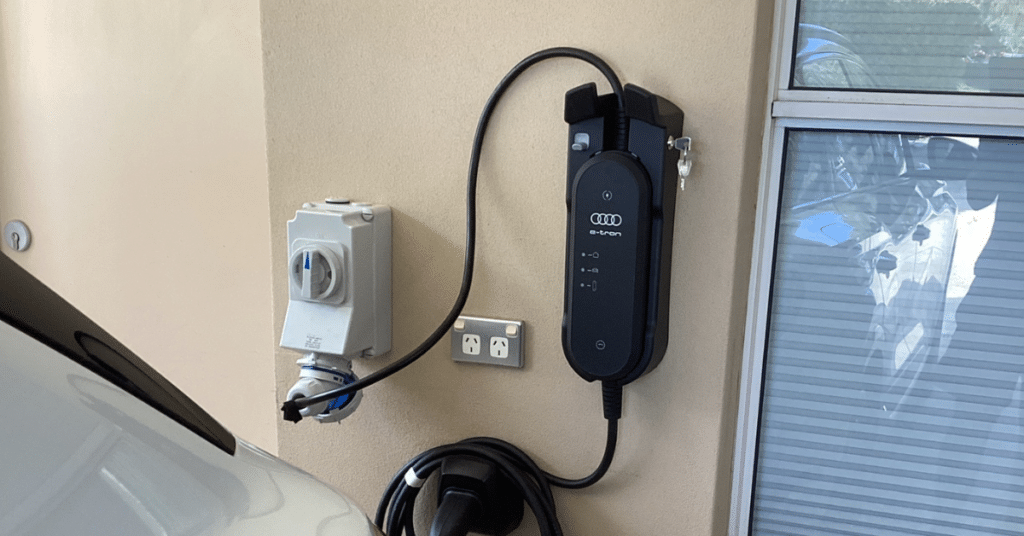
Most EVs come with a portable cable that plugs into a standard 10 amp power point. It’s the slowest way to charge, but it costs nothing extra to start.
According to the Electric Vehicle Council, a standard 10 amp power point typically adds 10 to 15 km of range per hour. Plugged in from 11pm to 7am, that’s roughly 100 km a night.
A power point can be enough if:
- you drive short distances most days
- you have a plug-in hybrid with a small battery
- you’re testing EV life before you commit to a charger
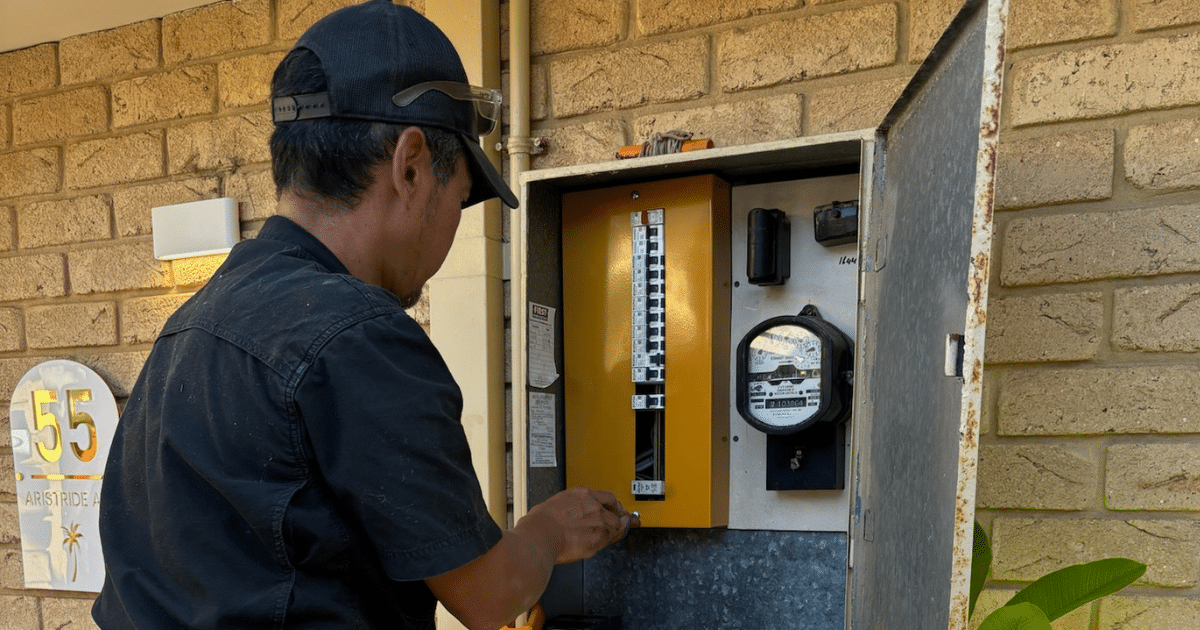
Things to watch: charging draws a steady load for hours at a time. The Electric Vehicle Council recommends a dedicated circuit if you’ll charge this way regularly, and a licensed electrician can check whether your existing power point and wiring are up to it.
Option 2: a dedicated wall charger
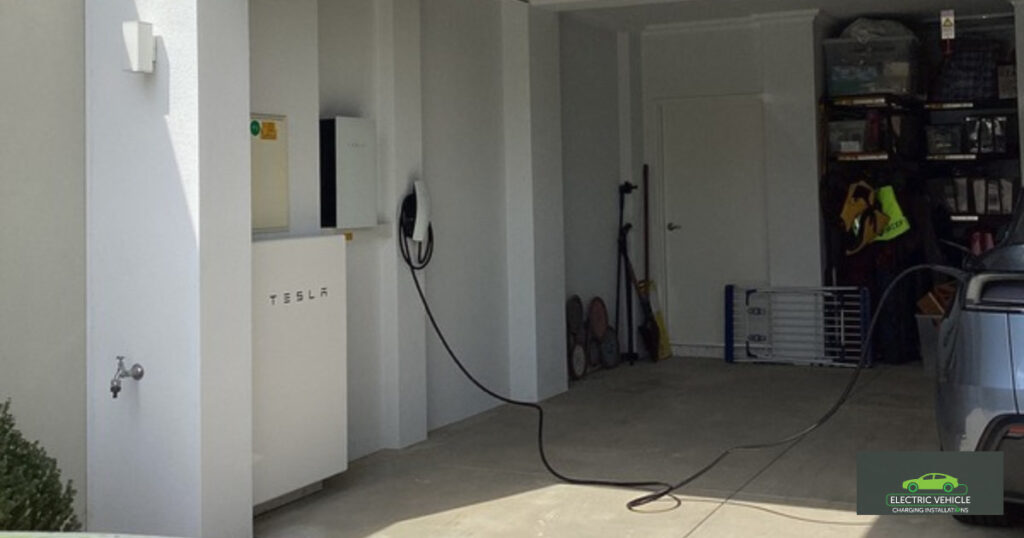
A wall charger (sometimes called a wallbox or home charging point) is fixed to your garage or carport wall and wired back to your switchboard on its own circuit.
- Single-phase homes: the most common home charger size is 7.4 kW, and it doesn’t need three-phase power.
- Three-phase homes: chargers of 11 kW or more need three-phase power. Not sure what you’ve got? Our guide to three-phase home EV charger installations explains the difference.
A wall charger charges much faster than a power point, so a typical day’s driving is topped up in a few hours rather than all night. Many also come with smart features, such as scheduling charging for off-peak times or using spare power from your rooftop solar.
Which one is right for you?
| If you… | A normal power point | A wall charger |
|---|---|---|
| Drive short distances most days | ✅ Often enough | Nice to have |
| Drive long distances, or share one EV between two drivers | ❌ May not keep up | ✅ Recommended |
| Have rooftop solar and want to charge from it | Limited control | ✅ Look for a solar-aware charger |
| Have a plug-in hybrid | ✅ Usually fine | Optional |
| Want the quickest top-up before heading out again | ❌ | ✅ |
The home chargers we install most
We install all major brands. These are the chargers we’re asked about most:
- Tesla Wall Connector Gen 3. Tesla’s own home charger. EVCI is recognised by Tesla as an installer. Read more about Tesla Wall Connector installation in Perth.
- myenergi zappi and zappi GLO. Popular with solar homes. EVCI is a myenergi Product Champion.
- Fronius Wattpilot. A good fit if you already have a Fronius solar inverter.
- Evnex. A smart charger with app control and scheduling.
Not sure which one suits your car and your home? That’s exactly what we work out at the site visit.
When to charge at home
When you charge matters as much as how. The Electric Vehicle Council suggests charging from solar during the day where you can. If you’re away during the day, charge at night (typically after 11pm) and avoid the 3pm to 9pm peak where possible.
If you’re with Synergy, our explainer on the Synergy EV Add-On plan covers the cheaper overnight charging window.
What installing a home charger involves
- Enquiry. Tell us your car, your home and where you park.
- Site visit. We check your switchboard, power supply and the best spot for the charger.
- Custom quote. A free quote tailored to your home, not a generic price.
- Supply and installation. Done neatly, with minimal disruption.
- Ongoing support. We’re here after the job’s done.
Some older homes need a switchboard upgrade before a charger can go in. We’ll tell you at the site visit if yours does. Every install comes with our 10-year workmanship warranty.
Frequently asked questions
Can I charge my EV from a normal power point?
Yes. Most EVs come with a cable for a standard 10 amp power point. It’s slow (around 10 to 15 km of range per hour, according to the Electric Vehicle Council), so it suits low daily driving or plug-in hybrids best. Have a licensed electrician check the circuit if you’ll use it regularly.
Do I need three-phase power to charge an EV at home?
No. A 7.4 kW single-phase charger is the most common home setup. You only need three-phase power for chargers of 11 kW or more. More in our three-phase guide.
How much does it cost to install an EV charger at home?
It depends on the charger, your switchboard and how far the charger is from it. Our guide to EV charger installation costs explains what affects the price, and quotes are free.
Is a home EV charger worth it?
For most drivers who charge at home regularly, yes. We weigh it up in Is a home EV charger worth it in WA?
Can I get an EV charger if I rent?
Often, with your landlord’s approval. See our renter’s guide to EV charger installation in Perth.
Ready to sort out car charging at home?
Get a free quote from Perth’s EV charging specialists
Electric Vehicle Charging Installations (EVCI) is Perth’s highest rated EV charger installer, with 350+ five-star Google reviews. Our certified team installs all major brands, from Tesla and myenergi to Fronius and Evnex, and every installation is backed by our 10-year workmanship warranty and ongoing support.
We’ll listen to what you need, explain your options in plain language, and give you a free quote tailored to your home or business. No generic prices, no jargon.
Prefer to talk it through? Call us on 0491 604 384.
We install across Greater Perth, Mandurah, Rockingham, Secret Harbour, Two Rocks, Yanchep, the Perth Hills and beyond Ellenbrook. Electrical Contractor Licence EC14555. Follow us on Facebook and Instagram for recent installs and charging tips.
Source for charging speeds and timing: Electric Vehicle Council, EV Charging at Home Guide.